You have to see this Geek video.
Amazing stuff
http://www.flixxy.com/solar-highways
19 February 2011


17 February 2011
So Who Blinked First?
Did Travelport blink or did AA?
Clearly AA moved first which gave the opportunity for Travelport to save some face.
However you have to wonder if this was a back door deal?
Either way - its good news for agents all round. But do remember boys and girls - this is a truce not the end of the war.
Cheers
http://www.tnooz.com/2011/02/16/news/american-airlines-drops-agent-fare-surcharge-over-travelport-row/
Clearly AA moved first which gave the opportunity for Travelport to save some face.
However you have to wonder if this was a back door deal?
Either way - its good news for agents all round. But do remember boys and girls - this is a truce not the end of the war.
Cheers
http://www.tnooz.com/2011/02/16/news/american-airlines-drops-agent-fare-surcharge-over-travelport-row/
14 February 2011
Back To The Future - QF's Avoiding Using The F Word
A really interesting commentary in the Sydney Morning Herald today. (Since the Professor is visiting Oz)
It concerns Qantas acquiring a certain - somewhat aged plane type from a now defunct but much celebrated Dutch airframe manufacturer.
Since he probably had to wince at the fact that the planes are powered by Rolls Royce - Mr Alan Joyce the Irish CEO of Qantas was being very careful with his words.
Press the link to see the article. It needs no embellishment from me.
G'day!
It concerns Qantas acquiring a certain - somewhat aged plane type from a now defunct but much celebrated Dutch airframe manufacturer.
Since he probably had to wince at the fact that the planes are powered by Rolls Royce - Mr Alan Joyce the Irish CEO of Qantas was being very careful with his words.
Press the link to see the article. It needs no embellishment from me.
G'day!
13 February 2011
Nervous Eyes On EXPE and OWW Monday Morning

After a rather calamitous collapse of both Expedia and Orbitz on Friday Feb 11th - all eyes will be on those stocks.
With a significant downgrade from Deutsche Bank last week - the midnight oil is probably being burned in Chicago and Bellevue.
With Amadeus announcing it was finally getting out of the Online World - but at a decent price - then surely OWW and EXPE should have been winners. Opodo is but a fraction of EXPE's traffic and clout.
PCLN is continuing to grow in stature and value.
And what of the airlines?

The airlines are trading pretty much as a group - other than United who seems to be the breakout guy.
Clearly when taken in context - the airlines and OTAs battle is not going unnoticed by the stock market.
Nail Biting time
Cheers
US Travel Up But Still Below Historic Highs

The US world of travel is growing again. We are seeing better numbers than last year. However we are still below the historic highs of 2006, 2007 and 2008.
ARC's numbers are looking healthy. Remember there are a couple of interesting elements you need to consider.
Ancillaries - those evil things - are hardly reflected in here as the revenue is currently only collected by the airline directly not via ARC.
The percentage of direct revenue is back to increasing. It has hovered at around 50% in recent months. Anecdotal evidence says that American experienced an increase in direct traffic as a percentage measurement of total sales. How that did compared to other airlines will have to be seen.
Finally the increase Y/Y is not as rosy as perhaps it could be. This is both a good sign and a bad sign. On the plus side it shows continuing restraint by the airlines. The bad news is that the passengers are not diving into their wallets and splashing out the cash.
So another year of a certain degree of uncertainty is ahead.
Cheers
Email Marketing Budgets Race Ahead
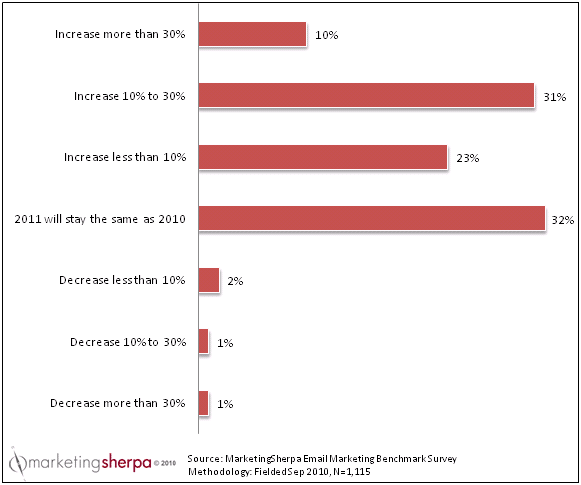
Well this is going to be a banner year for someone. Sadly probably not the traditional media.
Latest figures out indicate that despite getting somewhat tired - email marketing will see an increase in its budgets and not by a bit. 41% will show an increase of 10% or greater with only single digit estimating their budgets will decline.
For more details go across to Marketing Sherpa.
Cheers
The Dark Side Of Search
I think about search a lot these days. At dinner last night with some friends who have nothing to do with Travel - I tried to explain the issue of how search engine optimization affects what they do. When I got to a web browser to illustrate it - they were shocked.
We all know that Search is both good and well not so good.
I really hate the fact that it is SO EASY to game search. The various investigations of the Googleplex demonstrate that Google has a hard time providing true and unbiased search. In deference to the boys and girls there - this is NOT easy.
But I think we should all get to understand the reality that Search is being gamed - both legally (White hat) and illegally (black hat).
Oh yes - you guessed it - who gets to decide what is legal is of course Google - our very own 21st Century version of Big Brother.
So read this article from the New York Times it is very good
Cheers
We all know that Search is both good and well not so good.
I really hate the fact that it is SO EASY to game search. The various investigations of the Googleplex demonstrate that Google has a hard time providing true and unbiased search. In deference to the boys and girls there - this is NOT easy.
But I think we should all get to understand the reality that Search is being gamed - both legally (White hat) and illegally (black hat).
Oh yes - you guessed it - who gets to decide what is legal is of course Google - our very own 21st Century version of Big Brother.
So read this article from the New York Times it is very good
Cheers
For Valentines Day - 10 Reasons Why Luggage Beats Partners
So I will admit to being a bit of a softie.
When Professor Pamela of Cloud 12 PR send this to me - I could not resist it. And I am not one to actually to promote a product but for this time I will make an exception. You will have to find your own way to the company's website though ;-)
Cheers
Below are 10 of the reasons buying or gifting a high quality bag is a better emotional investment than embarking on yet another relationship:
1. Love doesn’t always last. Briggs and Riley luggage does.
2. You can rest assured that good luggage will not unzip when it shouldn’t.
3. Overstuffed luggage will never ask you if it looks fat
4. Your mother will always approve of good luggage
5. You can shut good luggage up and it will stay shut
6. Good luggage is always available for an impromptu romantic vacation
7. Good luggage actually makes your life easier
8. Good luggage won’t look you up on Facebook ten years from now
9. Good luggage will look as good on your 20 year anniversary as it did the day you bought it
10. Till death do us part is sort of morbid. A lifetime warranty isn’t.
Briggs and Riley offers the strongest guarantee in the industry. Simple as that®.
The guarantees that other brands offer have limits. Ours doesn’t. Our lifetime performance guarantee covers ordinary wear and tear, airline damage and is good on every bag we make.
When Professor Pamela of Cloud 12 PR send this to me - I could not resist it. And I am not one to actually to promote a product but for this time I will make an exception. You will have to find your own way to the company's website though ;-)
Cheers
Below are 10 of the reasons buying or gifting a high quality bag is a better emotional investment than embarking on yet another relationship:
1. Love doesn’t always last. Briggs and Riley luggage does.
2. You can rest assured that good luggage will not unzip when it shouldn’t.
3. Overstuffed luggage will never ask you if it looks fat
4. Your mother will always approve of good luggage
5. You can shut good luggage up and it will stay shut
6. Good luggage is always available for an impromptu romantic vacation
7. Good luggage actually makes your life easier
8. Good luggage won’t look you up on Facebook ten years from now
9. Good luggage will look as good on your 20 year anniversary as it did the day you bought it
10. Till death do us part is sort of morbid. A lifetime warranty isn’t.
Briggs and Riley offers the strongest guarantee in the industry. Simple as that®.
The guarantees that other brands offer have limits. Ours doesn’t. Our lifetime performance guarantee covers ordinary wear and tear, airline damage and is good on every bag we make.
The Nokia Burning Platform Memo
With special thanks to Professor Stephan for sending me the entire memo.
There is every now and then a seminal event that points out - usually the obvious - a basic truth. For as long as I can recall - Nokia was the platform of choice for Mobile. Nokia was an incredible company that made a huge bet on mobile and basically junked its other businesses in the 1990s because they realized they could not make it in a world populated by cheap clones - PCs and TV/Screens. Well it seems that they forgot the very lessons that got them to where they are today. History seems to be repeating itself.
So are their lessons in Travel? I really think so. I spoke to several of my former colleagues over the past week during the Travel Technology show in Earls Court London. I think some of them might still call me a friend - others not!
The memo from the new CEO of Nokia Stephen Elop could just as easily be written by the CEO of any one of the legacy GDSs except for one thing. They are still making money hand over fist.
BTW in terms of context - this was released before Nokia announced it was partnering with Microsoft to solve the Symbian problem. I am not sure that they have done themselves any favours.
So read this email and especially if you are working for a GDS and ask yourself what happened to your TRUE innovation. Then head the warnings. If you think you are doing the good job and you are totally in sync with your market - then ignore this and pay no attention at all. However if you are REALLY switched on - then compare the event at the show THack and then look at yourself in the mirror and tell me you are not just a tiny bit afraid...
You should be
Cheers
The email follows...
Hello there,
There is a pertinent story about a man who was working on an oil platform in the North Sea. He woke up one night from a loud explosion, which suddenly set his entire oil platform on fire. In mere moments, he was surrounded by flames. Through the smoke and heat, he barely made his way out of the chaos to the platform's edge. When he looked down over the edge, all he could see were the dark, cold, foreboding Atlantic waters.
As the fire approached him, the man had mere seconds to react. He could stand on the platform, and inevitably be consumed by the burning flames. Or, he could plunge 30 meters in to the freezing waters. The man was standing upon a "burning platform," and he needed to make a choice.
He decided to jump. It was unexpected. In ordinary circumstances, the man would never consider plunging into icy waters. But these were not ordinary times - his platform was on fire. The man survived the fall and the waters. After he was rescued, he noted that a "burning platform" caused a radical change in his behaviour.
We too, are standing on a "burning platform," and we must decide how we are going to change our behaviour.
Over the past few months, I've shared with you what I've heard from our shareholders, operators, developers, suppliers and from you. Today, I'm going to share what I've learned and what I have come to believe.
I have learned that we are standing on a burning platform.
And, we have more than one explosion - we have multiple points of scorching heat that are fuelling a blazing fire around us. For example, there is intense heat coming from our competitors, more rapidly than we ever expected. Apple disrupted the market by redefining the smartphone and attracting developers to a closed, but very powerful ecosystem.
In 2008, Apple's market share in the $300+ price range was 25 percent; by 2010 it escalated to 61 percent. They are enjoying a tremendous growth trajectory with a 78 percent earnings growth year over year in Q4 2010. Apple demonstrated that if designed well, consumers would buy a high-priced phone with a great experience and developers would build applications. They changed the game, and today, Apple owns the high-end range.
And then, there is Android. In about two years, Android created a platform that attracts application developers, service providers and hardware manufacturers. Android came in at the high-end, they are now winning the mid-range, and quickly they are going downstream to phones under €100. Google has become a gravitational force, drawing much of the industry's innovation to its core.
Let's not forget about the low-end price range. In 2008, MediaTek supplied complete reference designs for phone chipsets, which enabled manufacturers in the Shenzhen region of China to produce phones at an unbelievable pace. By some accounts, this ecosystem now produces more than one third of the phones sold globally - taking share from us in emerging markets.
While competitors poured flames on our market share, what happened at Nokia? We fell behind, we missed big trends, and we lost time. At that time, we thought we were making the right decisions; but, with the benefit of hindsight, we now find ourselves years behind.
The first iPhone shipped in 2007, and we still don't have a product that is close to their experience. Android came on the scene just over 2 years ago, and this week they took our leadership position in smartphone volumes. Unbelievable.
We have some brilliant sources of innovation inside Nokia, but we are not bringing it to market fast enough. We thought MeeGo would be a platform for winning high-end smartphones. However, at this rate, by the end of 2011, we might have only one MeeGo product in the market.
At the midrange, we have Symbian. It has proven to be non-competitive in leading markets like North America. Additionally, Symbian is proving to be an increasingly difficult environment in which to
develop to meet the continuously expanding consumer requirements, leading to slowness in product development and also creating a disadvantage when we seek to take advantage of new hardware platforms. As a result, if we continue like before, we will get further and further behind, while our competitors advance further and further ahead.
At the lower-end price range, Chinese OEMs are cranking out a device much faster than, as one Nokia employee said only partially in jest, "the time that it takes us to polish a PowerPoint presentation." They are fast, they are cheap, and they are challenging us. And the truly perplexing aspect is that we're not even fighting with the right weapons. We are still too often trying to approach each price range on a device-to-device basis.
The battle of devices has now become a war of ecosystems, where ecosystems include not only the hardware and software of the device, but developers, applications, ecommerce, advertising, search, social applications, location-based services, unified communications and many other things. Our competitors aren't taking our market share with devices; they are taking our market share with an entire ecosystem. This means we're going to have to decide how we either build, catalyse or join an ecosystem.
This is one of the decisions we need to make. In the meantime, we've lost market share, we've lost mind share and we've lost time.
On Tuesday, Standard & Poor's informed that they will put our A long term and A-1 short term ratings on negative credit watch. This is a similar rating action to the one that Moody's took last week. Basically it means that during the next few weeks they will make an analysis of Nokia, and decide on a possible credit rating downgrade. Why are these credit agencies contemplating these changes? Because they are concerned about our competitiveness.
Consumer preference for Nokia declined worldwide. In the UK, our brand preference has slipped to 20 percent, which is 8 percent lower than last year. That means only 1 out of 5 people in the UK prefer Nokia to other brands. It's also down in the other markets, which are traditionally our strongholds: Russia, Germany, Indonesia, UAE, and on and on and on.
How did we get to this point? Why did we fall behind when the world around us evolved?
This is what I have been trying to understand. I believe at least some of it has been due to our attitude inside Nokia. We poured gasoline on our own burning platform. I believe we have lacked accountability and leadership to align and direct the company through these disruptive times. We had a series of misses. We haven't been delivering innovation fast enough. We're not collaborating internally.
Nokia, our platform is burning.
We are working on a path forward -- a path to rebuild our market leadership. When we share the new strategy on February 11, it will be a huge effort to transform our company. But, I believe that together, we can face the challenges ahead of us. Together, we can choose to define our future.
The burning platform, upon which the man found himself, caused the man to shift his behaviour, and take a bold and brave step into an uncertain future. He was able to tell his story. Now, we have a great opportunity to do the same.
Stephen.
There is every now and then a seminal event that points out - usually the obvious - a basic truth. For as long as I can recall - Nokia was the platform of choice for Mobile. Nokia was an incredible company that made a huge bet on mobile and basically junked its other businesses in the 1990s because they realized they could not make it in a world populated by cheap clones - PCs and TV/Screens. Well it seems that they forgot the very lessons that got them to where they are today. History seems to be repeating itself.
So are their lessons in Travel? I really think so. I spoke to several of my former colleagues over the past week during the Travel Technology show in Earls Court London. I think some of them might still call me a friend - others not!
The memo from the new CEO of Nokia Stephen Elop could just as easily be written by the CEO of any one of the legacy GDSs except for one thing. They are still making money hand over fist.
BTW in terms of context - this was released before Nokia announced it was partnering with Microsoft to solve the Symbian problem. I am not sure that they have done themselves any favours.
So read this email and especially if you are working for a GDS and ask yourself what happened to your TRUE innovation. Then head the warnings. If you think you are doing the good job and you are totally in sync with your market - then ignore this and pay no attention at all. However if you are REALLY switched on - then compare the event at the show THack and then look at yourself in the mirror and tell me you are not just a tiny bit afraid...
You should be
Cheers
The email follows...
Hello there,
There is a pertinent story about a man who was working on an oil platform in the North Sea. He woke up one night from a loud explosion, which suddenly set his entire oil platform on fire. In mere moments, he was surrounded by flames. Through the smoke and heat, he barely made his way out of the chaos to the platform's edge. When he looked down over the edge, all he could see were the dark, cold, foreboding Atlantic waters.
As the fire approached him, the man had mere seconds to react. He could stand on the platform, and inevitably be consumed by the burning flames. Or, he could plunge 30 meters in to the freezing waters. The man was standing upon a "burning platform," and he needed to make a choice.
He decided to jump. It was unexpected. In ordinary circumstances, the man would never consider plunging into icy waters. But these were not ordinary times - his platform was on fire. The man survived the fall and the waters. After he was rescued, he noted that a "burning platform" caused a radical change in his behaviour.
We too, are standing on a "burning platform," and we must decide how we are going to change our behaviour.
Over the past few months, I've shared with you what I've heard from our shareholders, operators, developers, suppliers and from you. Today, I'm going to share what I've learned and what I have come to believe.
I have learned that we are standing on a burning platform.
And, we have more than one explosion - we have multiple points of scorching heat that are fuelling a blazing fire around us. For example, there is intense heat coming from our competitors, more rapidly than we ever expected. Apple disrupted the market by redefining the smartphone and attracting developers to a closed, but very powerful ecosystem.
In 2008, Apple's market share in the $300+ price range was 25 percent; by 2010 it escalated to 61 percent. They are enjoying a tremendous growth trajectory with a 78 percent earnings growth year over year in Q4 2010. Apple demonstrated that if designed well, consumers would buy a high-priced phone with a great experience and developers would build applications. They changed the game, and today, Apple owns the high-end range.
And then, there is Android. In about two years, Android created a platform that attracts application developers, service providers and hardware manufacturers. Android came in at the high-end, they are now winning the mid-range, and quickly they are going downstream to phones under €100. Google has become a gravitational force, drawing much of the industry's innovation to its core.
Let's not forget about the low-end price range. In 2008, MediaTek supplied complete reference designs for phone chipsets, which enabled manufacturers in the Shenzhen region of China to produce phones at an unbelievable pace. By some accounts, this ecosystem now produces more than one third of the phones sold globally - taking share from us in emerging markets.
While competitors poured flames on our market share, what happened at Nokia? We fell behind, we missed big trends, and we lost time. At that time, we thought we were making the right decisions; but, with the benefit of hindsight, we now find ourselves years behind.
The first iPhone shipped in 2007, and we still don't have a product that is close to their experience. Android came on the scene just over 2 years ago, and this week they took our leadership position in smartphone volumes. Unbelievable.
We have some brilliant sources of innovation inside Nokia, but we are not bringing it to market fast enough. We thought MeeGo would be a platform for winning high-end smartphones. However, at this rate, by the end of 2011, we might have only one MeeGo product in the market.
At the midrange, we have Symbian. It has proven to be non-competitive in leading markets like North America. Additionally, Symbian is proving to be an increasingly difficult environment in which to
develop to meet the continuously expanding consumer requirements, leading to slowness in product development and also creating a disadvantage when we seek to take advantage of new hardware platforms. As a result, if we continue like before, we will get further and further behind, while our competitors advance further and further ahead.
At the lower-end price range, Chinese OEMs are cranking out a device much faster than, as one Nokia employee said only partially in jest, "the time that it takes us to polish a PowerPoint presentation." They are fast, they are cheap, and they are challenging us. And the truly perplexing aspect is that we're not even fighting with the right weapons. We are still too often trying to approach each price range on a device-to-device basis.
The battle of devices has now become a war of ecosystems, where ecosystems include not only the hardware and software of the device, but developers, applications, ecommerce, advertising, search, social applications, location-based services, unified communications and many other things. Our competitors aren't taking our market share with devices; they are taking our market share with an entire ecosystem. This means we're going to have to decide how we either build, catalyse or join an ecosystem.
This is one of the decisions we need to make. In the meantime, we've lost market share, we've lost mind share and we've lost time.
On Tuesday, Standard & Poor's informed that they will put our A long term and A-1 short term ratings on negative credit watch. This is a similar rating action to the one that Moody's took last week. Basically it means that during the next few weeks they will make an analysis of Nokia, and decide on a possible credit rating downgrade. Why are these credit agencies contemplating these changes? Because they are concerned about our competitiveness.
Consumer preference for Nokia declined worldwide. In the UK, our brand preference has slipped to 20 percent, which is 8 percent lower than last year. That means only 1 out of 5 people in the UK prefer Nokia to other brands. It's also down in the other markets, which are traditionally our strongholds: Russia, Germany, Indonesia, UAE, and on and on and on.
How did we get to this point? Why did we fall behind when the world around us evolved?
This is what I have been trying to understand. I believe at least some of it has been due to our attitude inside Nokia. We poured gasoline on our own burning platform. I believe we have lacked accountability and leadership to align and direct the company through these disruptive times. We had a series of misses. We haven't been delivering innovation fast enough. We're not collaborating internally.
Nokia, our platform is burning.
We are working on a path forward -- a path to rebuild our market leadership. When we share the new strategy on February 11, it will be a huge effort to transform our company. But, I believe that together, we can face the challenges ahead of us. Together, we can choose to define our future.
The burning platform, upon which the man found himself, caused the man to shift his behaviour, and take a bold and brave step into an uncertain future. He was able to tell his story. Now, we have a great opportunity to do the same.
Stephen.
12 February 2011
Saturday Frivolity
The Professor still hates Twitter but has learned to appreciate it.
So today's joke should be funny for all. With special thanks to Professor Paul for sending it on to me.
A man walks in to the doctors and says,
"Doctor, doctor, I think I'm addicted to Twitter".
The doctor looks at him and says,
"Sorry, I don't follow you".
Bu buoom....
So today's joke should be funny for all. With special thanks to Professor Paul for sending it on to me.
A man walks in to the doctors and says,
"Doctor, doctor, I think I'm addicted to Twitter".
The doctor looks at him and says,
"Sorry, I don't follow you".
Bu buoom....
07 February 2011
Shhhh. More Reasons Not to Buy the Verizon iPhone
Perhaps I am being too hard on the devil's instrument.
You might recall my post last week on the second source for iPhones now coming from Verizon.
In the post I mentioned that there were some issues....
Well here are a few more.
Even though CDMA has the potential to go faster for the device... well its not really. According to several studies on the phone by journalists lucky enough to get their fingers on it - its a bit faster. Just not by much.
But here is another thought. You CANNOT do VOICE and DATA TOGETHER unless you are hooked up to wifi.
So you will need to make sure that you are in a good place with wifi (preferably for free) and your CDMA works for Voice. THEN you can multi task.
Wow that would be a great feature for the AT&T version or when roaming internationally. Oh but wait... you can't do that - CMDA doesn't work outside of the USA (except in VERY rare occasions).
OOOpppp might want to think again about that nice idea.
Cheers
You might recall my post last week on the second source for iPhones now coming from Verizon.
In the post I mentioned that there were some issues....
Well here are a few more.
Even though CDMA has the potential to go faster for the device... well its not really. According to several studies on the phone by journalists lucky enough to get their fingers on it - its a bit faster. Just not by much.
But here is another thought. You CANNOT do VOICE and DATA TOGETHER unless you are hooked up to wifi.
So you will need to make sure that you are in a good place with wifi (preferably for free) and your CDMA works for Voice. THEN you can multi task.
Wow that would be a great feature for the AT&T version or when roaming internationally. Oh but wait... you can't do that - CMDA doesn't work outside of the USA (except in VERY rare occasions).
OOOpppp might want to think again about that nice idea.
Cheers
05 February 2011
Are We Reaching Saturation In Transformation To Digital Media
There are a number of interesting trends that I follow. At the moment I believe we are starting to see a point of saturation in the adoption of digital media.
One of the stats I saw recently gave me pause for thought. The numbers in my view didn't make a lot of sense.

So I did a bit of poking around. This study is from Strata media. So the numbers for TV seem to be a bit high. Then you realize who owns them. Comcast.
So in my view these numbers are skewed against digital. So I would think that digital is already higher in value.
Perhaps now is the time to consider what happens when the rest of the world bails from the traditional media outlets and piles into digital. In my view this will be a bad thing especially for the smaller guy. Good of course for the Googleplex and the big digital properties such as Facebook.
UGH!!!
Cheers
One of the stats I saw recently gave me pause for thought. The numbers in my view didn't make a lot of sense.

So I did a bit of poking around. This study is from Strata media. So the numbers for TV seem to be a bit high. Then you realize who owns them. Comcast.
So in my view these numbers are skewed against digital. So I would think that digital is already higher in value.
Perhaps now is the time to consider what happens when the rest of the world bails from the traditional media outlets and piles into digital. In my view this will be a bad thing especially for the smaller guy. Good of course for the Googleplex and the big digital properties such as Facebook.
UGH!!!
Cheers
04 February 2011
Shhhh Don't Tell Anyone But Verizon has run out of iPhones and....

Well the running out was common knowledge. However you might want to think carefully about signing up for the service if you travel outside the country.
Why/
2 reasons - first one is that Verizon's main network will be the current version not the new LTE (we all have to wait for iphone 5 for that) which is GSM compatible.
And the other... well - just ask anyone who has an iPhone what its like to travel outside the USA.
The devil's instrument it is....
Cheers
Airline Dodge the First Bullet

WAY Baaaaaak when the debate over Ancillary Services started. I made a noise about the issue of Ancillaries actually costing the Government money.
It seems that at least someone was listening to the old Professor.
However it seems that the IRS ruled first that these services are not part of the ticket which set the scene for a government money grab. Well the airlines have dodged the first bullet.
Sen. Max Baucus one of the senators from the Great State of Montana says FAA bill won't include bag-fee tax. The Government Accountability Office said that a tax on baggage fees charged by airlines could raise roughly $240 million each year for the Airport and Airway Trust Fund. The Senator is chairman of the Senate Finance Committee, he said that he will not propose such a tax as part of a bill reauthorizing the Federal Aviation Administration.
Dont expect this situation to last that long. I am sure that there are many States who are looking at this from a revenue perspective. With the DoT now in the process of finding ways to monitor the ancillaries - we can be assured that as soon as they figure this out - they will indeed then work out a way to tax it.
Cheers
With thanks to ChukyPita for the great image
The sure things in life are death and taxes.
02 February 2011
So You Think Social Media Is Important?

According to a study released in January 2011 from the University of Massachusetts Dartmouth Center for Marketing Research, those who try Social Media - seem to like it and now the importance has spread mainstream with the following chart as provided by eMarketer.

Well it would seem you are in good company.
What still bothers me a little is that while we move from eCommerce to F-Commerce or is it SM-Commerce - in my view we are moving towards more and more near or actual real time commerce.
Great - BUT.... will the back end systems (which is my specialty) keep up? The truth is out there somewhere - but the legacy systems model of contract based agreements as opposed to real time technologies will come under a lot of pressure. The ability of cache to be real and accurate with trust - becomes a lot harder.
I have opined before that the demands of Social Media based commerce and individualized results is a recipe for disaster for legacy systems. This seems to get confirmed at every turn. Last year - at the OTA meeting in Seattle - the CTO for Pegasus demonstrated how search is driving more and more transactions but not driving more sales or profit. Indeed the corollary is true. The harder the user searches to get better pricing the lower the yield and the greater the cost of the transaction.
Anyone still stuck in the legacy world - (are you listening GDSs) - and not paying attention to this issue is either guilty of monopolistic or ostrich behaviour. Possibly both.
The emergence of next generation FIND vs explicit search demands better back end infrastructure.
And yes - the emerging companies get this. Those who are sticking to the old model. Your time is up. Time for you to get out of the way... and close the door on the way out.
Cheers
With special thanks to the Dr Who Tardis money box. http://gadgetsin.com/uploads/2010/09/doctor_who_tardis_money_bank_2.jpg

Exploiting "Like" Is A Slippery Slope.
Call me old fashioned - but when I like something, it should have meaning and be relevant and something that represents a real attribute.
In today's somewhat hedonistic environment where subtlety and nuance have been replaced by quantity over quality and arbitrary measurements of both - the word LIKE has become a victim to over use in the same way that - well - Windows has.
Until now I didn't pay attention to things like (meaning similar to) the "Like" button on Facebook. To me the misuse was abundantly clear. People are sitting there clicking the "Like" button like chimpanzees in the zoo. Click the button and you get something. The Pavlovian response becomes a normal conditioned response rather than a meaningful expression of human emotion.
However the use of the "Like" button has become part of the mechanism of relevance. Another component of the "Gaming" of the system of search that reduces our human ability to express ourselves in ways that - shall we say define our humanism. IE what differentiates us from a machine.
Don't believe me?
On December 15th 2010,amongst many Bing announcements that day - the Search Division of Microsoft announced even deeper integration of Facebook data into Bing’s search results and rankings. Up to this point Bing had integrated “liked” content from Facebook into its search results in a distinct content areas. The change was that now it was using the "Like" as a general criteria for ranking. Further the only viable Google Search alternative now openly states that your friends’ Facebook activity will be “influencing ranking on Bing and will lead to personalized search rankings.”
As several analysts point out the basic risk here is that social media “gaming” will lead to clutter in Bing’s search results. Not only that (clutter) but also all the bots and scripts - malicious or benign - will now skew results. While this is supposed to be just an opt-in feature and disconnecting your Facebook account with Bing turns off the addition of “likes” in your Bing search results - we all know that the default situation is to leave it turned on and results will again be skewed permanently. Or at least until the geniuses in Redmond try another feature to out Google Google or simply because they were bored that day and had nothing else to do now that stock clock watching has ceased to have any meaning on the Campus astride the 520 Freeway.
Not to be outdone - the droids from the Googleplex confirmed that they too were happily using Facebook, Twitter and other social media services to influence their rankings.
Thanks to Professor Paul for pointing out perhaps the drivers for this. It took me a little while to cotton on - but after looking at the latest financials from Google it starts to make sense. Google is seeing basic search as a declining share of their gross revenues. With about as much ad revenue sucked from the traditional media as has already converted - social media and social "ad dollars" are where the growth action is. (Chart courtesy of eMarketer).

To me this is all very scary. I see that the human levels of emotion - ranging from love to hate are being turned into machine comprehensible elements. Thus in turn making machines more easily capable to replicate human activity. Let's face it the machine already has an advantage. In this phase of human development unlike any other development before it - we do not have the power to harness the result. Consider previous developments: Fire, speed etc. in each of those cases the human intellect was able to master the power unleashed and contain it. This time the actual power unleashed is synthetic intellect. Dumbed down into forms that the machine can demonstrate its superiority we are now at the disadvantage of the machine who has infinite memory and ordering capability. Reducing our humanism to facsimiles of differentiated components such as love and hate, heart and soul if you will then synthesizing these factors into the "wisdom" of the crowd reduces our ability to display the uniqueness of our true ourselves.
And if nothing else it means we will now be guaranteed to lose in Jeopardy and Alex Trebak will not be needed either. Click on the link to see the wired story on how IBM's SuperComputer Watson will compete against two of the winning-est contestants of the American Game Show.

And this is why it makes me sad (human emotion) and just a little scared.
Er. cheers?
In today's somewhat hedonistic environment where subtlety and nuance have been replaced by quantity over quality and arbitrary measurements of both - the word LIKE has become a victim to over use in the same way that - well - Windows has.
Until now I didn't pay attention to things like (meaning similar to) the "Like" button on Facebook. To me the misuse was abundantly clear. People are sitting there clicking the "Like" button like chimpanzees in the zoo. Click the button and you get something. The Pavlovian response becomes a normal conditioned response rather than a meaningful expression of human emotion.
However the use of the "Like" button has become part of the mechanism of relevance. Another component of the "Gaming" of the system of search that reduces our human ability to express ourselves in ways that - shall we say define our humanism. IE what differentiates us from a machine.
Don't believe me?
On December 15th 2010,amongst many Bing announcements that day - the Search Division of Microsoft announced even deeper integration of Facebook data into Bing’s search results and rankings. Up to this point Bing had integrated “liked” content from Facebook into its search results in a distinct content areas. The change was that now it was using the "Like" as a general criteria for ranking. Further the only viable Google Search alternative now openly states that your friends’ Facebook activity will be “influencing ranking on Bing and will lead to personalized search rankings.”
As several analysts point out the basic risk here is that social media “gaming” will lead to clutter in Bing’s search results. Not only that (clutter) but also all the bots and scripts - malicious or benign - will now skew results. While this is supposed to be just an opt-in feature and disconnecting your Facebook account with Bing turns off the addition of “likes” in your Bing search results - we all know that the default situation is to leave it turned on and results will again be skewed permanently. Or at least until the geniuses in Redmond try another feature to out Google Google or simply because they were bored that day and had nothing else to do now that stock clock watching has ceased to have any meaning on the Campus astride the 520 Freeway.
Not to be outdone - the droids from the Googleplex confirmed that they too were happily using Facebook, Twitter and other social media services to influence their rankings.
Thanks to Professor Paul for pointing out perhaps the drivers for this. It took me a little while to cotton on - but after looking at the latest financials from Google it starts to make sense. Google is seeing basic search as a declining share of their gross revenues. With about as much ad revenue sucked from the traditional media as has already converted - social media and social "ad dollars" are where the growth action is. (Chart courtesy of eMarketer).

To me this is all very scary. I see that the human levels of emotion - ranging from love to hate are being turned into machine comprehensible elements. Thus in turn making machines more easily capable to replicate human activity. Let's face it the machine already has an advantage. In this phase of human development unlike any other development before it - we do not have the power to harness the result. Consider previous developments: Fire, speed etc. in each of those cases the human intellect was able to master the power unleashed and contain it. This time the actual power unleashed is synthetic intellect. Dumbed down into forms that the machine can demonstrate its superiority we are now at the disadvantage of the machine who has infinite memory and ordering capability. Reducing our humanism to facsimiles of differentiated components such as love and hate, heart and soul if you will then synthesizing these factors into the "wisdom" of the crowd reduces our ability to display the uniqueness of our true ourselves.
And if nothing else it means we will now be guaranteed to lose in Jeopardy and Alex Trebak will not be needed either. Click on the link to see the wired story on how IBM's SuperComputer Watson will compete against two of the winning-est contestants of the American Game Show.

And this is why it makes me sad (human emotion) and just a little scared.
Er. cheers?
The Bright Spot In the US Economy - TRAVEL!!!
Gary Locke (who used to be the Gosvenor of the Great State of Washington (where I live) was yesterday touting the benefits of Travel and Tourism to the US Economy.
At a meeting of the Commerce Department's Travel and Tourism Advisory Board today, Commerce Secretary Gary Locke announced a 47 percent surge in the travel and tourism trade surplus in 2010; the surplus now exceeds $28 billion. The United States welcomed more than 55 million international visitors during the first 11 months of 2010, 11.4 million more visitors than the year before. While international visitation increased 10 percent, international visitor spending increased 11 percent to $122.7 billion. The travel and tourism industry employs nearly 8 million people across the United States.
While the airlines have been cutting back to the extent that only 500K people work for US airlines with a smattering of other foreign carriers - that makes Airlines total employment about 6% of the total.
Even adding back in the GDS staffers - it doesn't do a heck of a lot for the market. But the burgeoning IT businesses will bring some entrepreneurship to the market. Provided of course that this is not stifled by some insane notions of transparency.
Cheers
At a meeting of the Commerce Department's Travel and Tourism Advisory Board today, Commerce Secretary Gary Locke announced a 47 percent surge in the travel and tourism trade surplus in 2010; the surplus now exceeds $28 billion. The United States welcomed more than 55 million international visitors during the first 11 months of 2010, 11.4 million more visitors than the year before. While international visitation increased 10 percent, international visitor spending increased 11 percent to $122.7 billion. The travel and tourism industry employs nearly 8 million people across the United States.
While the airlines have been cutting back to the extent that only 500K people work for US airlines with a smattering of other foreign carriers - that makes Airlines total employment about 6% of the total.
Even adding back in the GDS staffers - it doesn't do a heck of a lot for the market. But the burgeoning IT businesses will bring some entrepreneurship to the market. Provided of course that this is not stifled by some insane notions of transparency.
Cheers
01 February 2011
And The Bad Boy Winner - By a Hair?
American Airlines
The vote tally was as follows:
In who is the bad boy in the Orbitz dispute:
AA 55%
Expedia 16%
Orbitz 16%
Travelport 50%
The audience has spoken.
Check out my latest poll. Bundled vs Unbundled... not your typical options
Cheers
The vote tally was as follows:
In who is the bad boy in the Orbitz dispute:
AA 55%
Expedia 16%
Orbitz 16%
Travelport 50%
The audience has spoken.
Check out my latest poll. Bundled vs Unbundled... not your typical options
Cheers
31 January 2011
ANZ's 5000 Quid Boat Anchors aka Skycouches

Air New Zealand has been pretty aggressive in the Social Media space. They have also been a very innovative airline. Their Skycouch idea (or should it be Sky Chaise?) product has been much promoted.
But the Professor was less than enthused when I first saw some pictures of it. And nothing that has been written has made me any more enthusiastic about the concept. Exactly one year ago today (Jan 31st 2010) I wrote a less than complimentary review of the product.
Now the pricing for the product has been revealed. There are some gasps and shock on the pricing. None other than Business Traveller (yes 2 Ls) the UK magazine and advocate for the premium frequent flyer has just written a review of the price.
Ooops.
It seems that the pricing is rather more than even the most optimistic player was expecting. Remember that in 2009 NZ was offering a RTW fare for less than 500 pounds.
As one comment opined - they are going to be lightly used and then gone the way of Airline Ash Trays.
I have a sneaking suspicion that this person may just be right. What is somewhat sad is that the other innovation the Premium Economy product is pretty good and better than many a business class product.
As this picture shows - the real problem. Here is an attractive person trying out the new seat with her feet dangling in the aisle. Well those of us who regularly fly know that is a huge No No. The seat is just not going to be that comfy.
But now let's think. Will NZ start offering premium service to those who buy these seats?
I can just hear the boarding announcements.
"Ladies and Gentlemen (with a slight Kiwi Twang) Welcome to NZ1 we will be boarding the flight today by priority.
We would like to invite our passengers seated in the Business Premier Cabin first,
We would like to invite our Koru club members next.
Our Star Alliance partners - sorry but all the variations are so many that just look at your card and as long as its any type other than silver or does not have a colour in it then you can board next. Please go to the door marked 'Special'
Next if you are on United's Code Share flight and you thought you were getting that extra 5 inches of leg room - you can now board. WAIT FOR IT.... WHERE ARE YOU GOING SIR - I HAVEN'T TOLD YOU WHICH DOOR YET....Anyone who has a Star Alliance card of any type including those of you who bought Premier Status on United for more than $1300 - you can join the door marked "Bovine Use Only".
I would now like to invite those travelling with certified children under the age of 5 to now board.
Any of you over 65 or just need a little extra time waddling down the jetway - your turn.
Now those of you who paid WAY too much for the Poofy seats aka the Sky Counches. You may board while I try to keep a straight face. And don't expect any metal on your meal tray. And yes you too can join through the door marked Bovine. Right about now it should be a bit tight and smelling nicely ripe in there.
Finally anyone left? No? Good now we can go"
Cheers
Subscribe to:
Posts (Atom)