Showing posts with label US Airways. Show all posts

21 April 2012

US Airways... Are You Insane?


OK so let me see if I can get this right. I am an airline who is in trouble because my costs are too high. Costs are too high for many reasons such as from bad contracts, bloated staffing etc etc.

 I enter bankruptcy to correct this situation.

My largest cost base doesn't want me to cut his benefits and staffing levels. (Understandable on all sides).

An external suitor who still hasn't got his house (like sorting pilot seniority lists) in order, makes deal to keep said cost levels high. (At the same time screwing his own unions).

Did I miss something?

Just for clarification - I don't doubt the sincerity of all concerned. It just seems to be illogical. 

Cheers


(Picture taken from AA 757 over Lake Michigan)

25 April 2011

Is It All Really JUST About The Money? Airlines & GDSs To Duke It Out In Court


Sabre and Travelport - both private companies - have become the target of 2 lawsuits alleging Anti Trust behavior by AMR's American Airlines unit and US Airways. American Airlines is suing Travelport and its affiliate public company Orbitz (OWW). US Airways is suing Sabre. Both suits are similar in nature. At stake is the very nature of airline distribution in not just the USA but around the world. This analysis will hopefully provide the context of the battle. Sabre is controlled by 2 players - TPG and Silverlake Partners. Travelport is largely controlled by Blackstone.

It seems to have been a really busy time in airline distribution lately. We have had many things going on – so perhaps we should consider what is driving some of the changes going on. For many who are in the business – this battle has been a long time coming. However for the rest of the world and many others – this has caused a strong degree of head scratching. Consider this a primer on the core issue of control.

Let's just look at some of the major issues that have surfaces since October. This was the month when AA's battle with Orbitz burst into the open. Soon to be joined by Travelport, Expedia, and Sabre. Just looking at the last few weeks - I don't think we have seen such activity in a long time. Here is a list of some of the news stories over the past few weeks that have seemed to be disconnected. Here is a partial list:

• Expedia settled its battle with AA and committed to a Direct Connect – in doing so Expedia abandoned the GDS only model and agreed to go the direct connect route as well as signing its first LCC for Direct Connect – Air Asia in a far reaching Joint Venture.
• Delta Airlines signs with Farelogix to create alternative distribution services for the nation’s second largest carrier making a clean sweep of all the major North American carriers are now signed up to participate with the Farelogix platform. AC, UA, CO, AA, DL, US. Delta also makes the 13th Airline to have publicly committed to the system.
• The FAA Re-authorization bill passed without the GDS provisions that were defeated 3 times during the passage of the bill.
• The DoT issued new passenger regulations but in issuing this new "Passenger Bill of Rights" it declined to force (for the short term at least) provisions which would have made the airlines display ancillary services via the GDS.
• AA filed suit against Travelport and its affiliate company Orbitz Worldwide (owned 48% by Travelport) alleging anti trust behavior.
• US Airways filed suit against Sabre also alleging anti trust behavior.
• The DoJ after a lengthy evaluation approved the Google/ITA deal – the deal has now closed.


Are these unrelated? I don’t think so. But let me just focus on the 2 lawsuits.

For a minute let's just consider what is driving their thought processes. I am taking this from the perspective of the parties who filed the suits. We have not yet seen the defense other than both parties (Sabre and Travelport) has said they will vigorously defend their position. I have opined before that in my view Travelport’s statements lack some substance and so far have contained some factual inaccuracies but since they have not filed a formal brief – this can be construed as PR spin. . Don’t forget GDSs and Airlines can hire some pretty serious legal firepower. This battle is not new. Don’t think for a minute that the Airlines have not just woken up yesterday and said - "we're bored, let's go after the GDSs". This battle was clearly a very long time coming.

Both lawsuits (AA vs Travelport/OWW and US vs Sabre) are very explicit in what they want and the respective positions. While they appear to be similar - each airline comes from a very different space. The AA lawsuit is somewhat of a pre-position. The US suit is backward facing for the contract it already signed.

The AA lawsuit actually names Sabre several times in its suit against Travelport. AA has made its sentiments known that it feels the GDS model needs to change. Possibly after 9/11 and perhaps we can trace the lineage of the battle to the very moment that Sabre was spun out and AMR (AA's parent) put the resulting cash in its pocket. US Airways however is not quite in the same position. They are the smallest of the big airlines (Now comprising just 5 in the USA). They never owned a GDS. This makes them the least able to apply leverage in the ongoing battles. They also have effectively put themselves up for sale by delivering a message that consolidation is not yet over and that US Airways is ready to be merged into another airline - AA according to analysts - perhaps being the favorite. One could even opine that US is trying to ingratiate itself with AA. I make this point because I believe US Airways thus is not arguing from any position of strength. Ultimately in terms of scale we have to remember that the market share of each of the major American GDSs exceeds that of any airline in the USA market.

The driving forces for the lawsuits are that the airlines believe they asked nicely (well as nicely as an airline can) that the GDS behave differently. IE that the GDSs change their model. The GDSs refused both publicly and privately to budge. Indeed they went on to consider any change should be viewed as a nasty attack on their core business model, for which a vigorous defense needed to be mounted. Were the airlines napping on the job? Perhaps yes they were for a while. They thought they had a deal with the GDSs.

in 2006 the airlines and the GDSs entered into a form of social contract. The background at that time was that the GDSs were scared that the Airlines would provide content on their own websites that could not be seen on the GDSs. Thus moving both the trade as well as the consumer to more favourable content on the airlines own sites. The genesis of the Full Content Agreements was that the Airlines would give the GDSs full content in exchange for reduced fees. (I want to avoid using the term discounts which is how the GDSs saw this). This social contract worked pretty well because essentially all the major legacy carriers signed up for it.

In airline distribution - the traditional basis of the distribution landscape is one for all and all for one. Or as I prefer to characterize it as "one size fits everything." However the GDSs lawyers might have been smarter than the airlines' lawyers. Why? Because the GDSs managed to put in a number of provisions that created a far stricter contractual environment. So the issue of full content tied with a number of other provisions gave the GDSs a distinct edge. At the same time the GDSs started down a path of increased tighter contract provisions with their user community; the travel agents - the subscribers. In doing so they created a Gordian Knot. The airlines were trapped. The subscribers were trapped. The analogy - admittedly somewhat extreme - but humour me here I think you will find the comparison is not that odorous - it could be likened to a drug cartel (aka the GDSs) were able to control distribution.

But let’s not shed too many tears for the airlines. In the early part of the millennium the airlines ceased to provide compensation in the form of standardized sales commissions to the agencies. Thus the agency players and the airlines ceased to have a compensated relationship. They still however retained a contracted relationship either directly or via ARC. The corporate customers of the agencies allowed the water to flow downhill by paying the increased freight of an access fee for use of the agencies' services. Thus these agencies - TMCs - were able to transfer from a supplier paid fee model to a consumer paid fee model - a transition that went remarkably well. Even the leisure agents tried this for a while but this fell apart when Priceline refused to join the fee based model. In recent years the other OTAs - largest players such as Expedia and its fellows abandoned the fee model for leisure bookings. Sadly the independent small agents were not so lucky and this effort drove many of them out of business. From a peak in the mid 1990s to today the number of agency locations has collapsed from 55,000 to now below 20,00 outlets.

Thus there is dissonance in that the travel agents are in many cases not directly compensated for selling airlines product. This somewhat advantaged position works for the airlines because they regard their product as being valuable and that the consumer and their channels should pay to access the product. This conveniently forgets that the agents actually do add value in aggregating content for the creation of neutral offers to their consumers a core value proposition for the consumer.

The GDSs too started playing a number of games. Firstly they had created an artificial MSRP pricing structure and backed it up with the charade of saying they were providing large discounts to the airlines. How much of a charade? Even after allowing for the cut rate prices -Amadeus's margin in 2010 as provided by their annual reports show a margin of 48% on its GDS business alone. The other publicly available information for Travelport shows that its margins declined from a peak of 33% in mid 2009 to the current level of 28%. (Does Amadeus know something that Travelport doesn’t?) We can safely assume that Sabre is in the same ballpark. The average segment fee (net revenue) for each company was as follows:

Travelport – rose from $3.47 in Q1 2007 to $5.83 in Q4 2010.
For Amadeus we only have data from 2009 which shows the revenue per segment rose from (Q1 2009) $3.28 to just under $5. ($4.97 in Q4 2010) when converted from Euros to Dollars.

So despite the social contract between the GDSs and the airlines the actual cost to the airlines rose significantly during this time. NOTE I am using publicly available information and you can find this out for yourself on the websites of Travelport and Amadeus.

Indeed one could argue that the social contract was flawed to begin with but the GDSs (now fully controlled by the money guys in the form of Private Equity/Venture Capitalists) had obligations to increase their margins. How did they do that? They cut costs by slashing payrolls, cutting pure R&D and by changing their agreements.

In the case of Travelport there were significant synergies gained by the merging of the Worldspan and the Galileo businesses. However Travelport was upfront and said it would not bite the big one and merge its (now 3) GDSs into a single code base. In my analysis all the GDSs gained incremental net revenue through two techniques. Through unbundling their core segment fees, long before the airlines became effective at unbundling – the GDSs were doing this and made good money from it. But they also changed the contracts to further tie the airlines. At the other end they were able to generally reduce the cost of the subscriber delivery through cutting back on services. But the one area that they could not cut was in the segment incentive fees (aka as US Airways describes them “Kickbacks”). The competition for smaller pie – i.e. the reduced agent community – meant that the GDSs had to pay ever increasing incentives to the agencies to ensure a reliable user base. What happens is simply the GDSs take a portion of the fee that the airlines pay and kick back this portion to the travel agents.

To examine this - have a look at Travelport's 2007 and 2010 end of year financials.

2007

Cost of revenue.....................................$1,167
Selling, general and administrative......$1,286
Separation and restructuring charges.......$90

2010

Cost of revenue.....................................$1,164
Selling, general and administrative...........$547
Restructuring charges..............................$19

I think you get my point. During this time Travelport's segment count fell from 416.2 Million to 349.4 Million segments (all 2007 vs all 2010).

Rumours abound of the amounts paid not just to get agents to switch but also just to stay in place. These payments are so large in more than one market the asking price for a GDS segment incentive is $4.00. To cover this cost the GDSs must be indeed cross subsidizing the bigger agents (i.e. those with market power) from two places firstly the weaker and smaller agents who tend to be brick and mortar; secondly from those markets where they don’t have to provide incentives due to their market power – which today are very few.

In addition to the core issues above – the airlines feel that the GDSs have not kept up the investment in two key areas. Functionality to support the sale of ancillary and unbundled products (seats, bags credit card charges etc). The other charge is that the GDSs have actually inhibited the ability of the airlines to sell personalized services via the intermediary channels. For whatever reason - the GDSs do not provide these services today except in very few cases.

The core of the arguments that the airlines feel harmed is not just based on cost. But ultimately it is based on the argument of who controls distribution. So these lawsuits are about breaking the Gordian Knot.

Want to read some more?… actually you could have largely done a cut and paste of the law suits by going to a not quite so obscure website and downloading the Airlines comments on the US DoT NPRM concerning the Passengers Protection. Last week the US DoT turned this into law. Curiously only after two events. Event 1 - the Dept of Justice had approved the Google Acquisition of ITA Software. Event 2 – the FAA bill was approved by the US Congress. Coincidence?

The final rule making is here: DOT-OST-2010-0140

For AA’s comments on this rule making go here:
For US’s comments go here:

So now you know – where you sit in the debate should at the very least be powered by the information to hand.

I recommend that you go through the other submissions on the dockets. There is a lot of material in there. Then sit back and think – are these events connected? Yes. Is my answer. However the airlines feel emboldened by the changes coming. What we are seeing is nothing short of a fundamental shift in Airline distribution.

Catch the wave. Open Distribution is with us.

Cheers

08 April 2010

UA and US Chatting

Somewhat rebuffed by a stable CO - UA has turned to US as a potential merger partner.

This seems to have the rather rancid smell of 2 bad airline models (despite improvement) trying to get to scale. (Hello doesn't anyone look at history?).

So let's hope that UA sees the error of its ways and goes back to nesting with CO.

Still they just might actually do it - after 2 prior attempts in 2008 and previously in 2000 - this just could happen. Not sure that would be good.

Cheers

25 March 2010

Should US Airways Be Given Exemption At PHL?

Hoping to slide in the request for an exemption for their operations in the heavily congested north east USA, US Airways is hoping to be exempted from the upcoming performance based customer charter due to arrive next month.

So the question is should the airline (based in sunny Arizona) be excused the delay rules. Remember that several airlines including American Delta and Jetblue have requested exemptions for JFK and Continental has requested the same for EWR based on the current situation (one runway is out at JFK) and in general for the ATC congestion there.

The new DOT rule states that if domestic flights sit on the tarmac for more than three hours with passengers aboard, airlines face a fine of up to $27,500 per passenger. Thus airlines will be more likely to cancel a flight rather than paying heavy fines.

Note that at the present time the US DoT has not ruled on these requests. The new regs come into force next month.

In my opinion there is a case to be made for the current JFK situation until the runway resurfacing project is complete. But whether the others are eligible - that is a different matter.

Cheers

24 January 2010

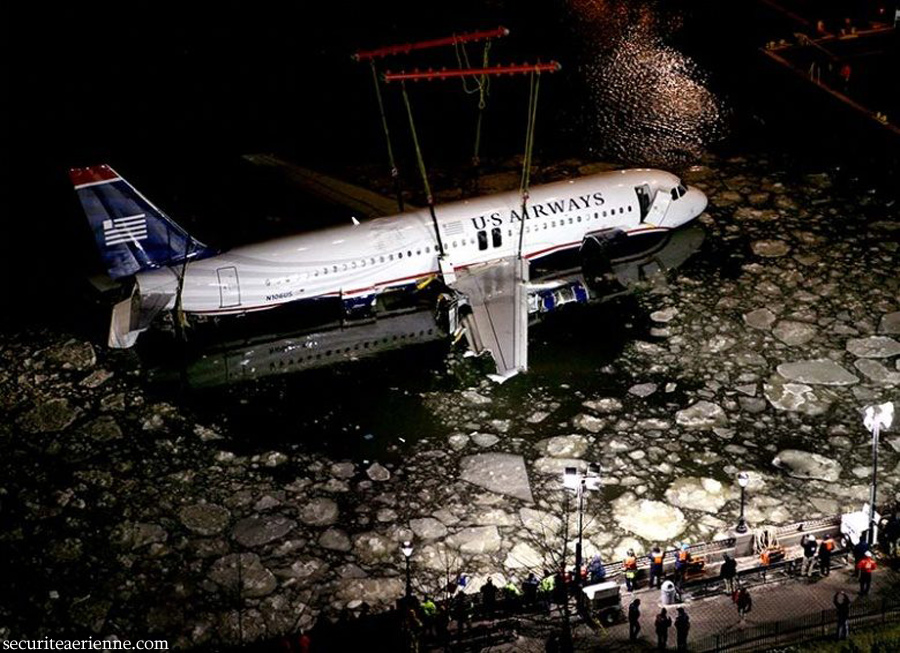
Psst Want A Bit Of US106?


So here are some definitive stats on the slightly water damaged US106 plane.

First Factual:

Announcement Regarding Flight #1549: Information on Aircraft
Involved in Accident
Jan. 16, 2009
Type: Airbus A320-214
Built: June 15, 1999
Length of Service with US Airways: Nine years (Aug. 2, 1999) - Delivered to US Airways from new.
Aircraft Lessor: Wells Fargo Bank Northwest, National Association as Owner Trustee
Previous Operator: N/A
Number of Cycles (a cycle equals one take-off and one landing): 16,299
Number of Flight Hours: 25,241.08
Aircraft Checks:
Date of last A-Check (maintenance inspection performed every 550 flight hours) –
Dec. 6, 2008
Date of last C-Check (annual, comprehensive aircraft inspection):
April 19, 2008
Engines: CFM56-5B4/P
Installation Date Total Flight Hours
Engine 1 (left): Jan. 15, 2008 19,182.10
Engine 2 (right): May 28, 2006 26,466.08

The insurer was Chantis. Actually this is the old AIG Insurance unit that has been placed into a special vehicle while the US Government bails out AIG.

The aircraft has been offered for sale as scrap. And lots of people are interested.

So go here to see the pictures and then you can even register to bid.

Chantis/AIG have had so much interest in the plane that they have even put up a little notice to that effect.

http://www.aigaviation.com/aviationsalvage/management/newsdocs/N106US.pdf


Cheers

29 October 2009

The Winter Cutting Season Is Upon Us

Airlines are starting to go through another round of rationalization and cuts.

AA who last quarter cut a number of operational people is going to shut down its maintenance base in MCI. For those of you who are historians or just a little sentimental this was TWA's base. This is for me personally sad since I worded for TWA/PARS during the 1980s in MCI. AA is eliminating about 700 jobs in total most of them in Kansas City. This is on top of a number of customer service and flight attendant jobs in the last quarter.

US Airways is also cutting a little piece of history. It is essentially throwing in the towel on the LAS hub. The whole cutting of the former HP hub started at the height of the fuel crisis last year when they canceled the night hub. With a significant cut back in traffic to LV - the local Tourism is going to take a hit. The carrier cutting 1,000 jobs next year, shifting virtually all of its flights to its three hubs and suspending several international routes. “It’s a major retrenchment,” said Chairman Doug Parkers. The airline will also deploy smaller aircraft on the shuttle runs.

There will be more.

12 August 2009

The Big US East Coast Switcheroo

Well the dust is clearing on the giant switch of airport slot assets on the US East Coast. It started yesterday with Continental and Air Tran doing a relatively small switch. AirTran AP reported planned to swap some Newark landing slots with Continental Airlines’ slots in Washington and New York, effective 25-Oct-09 AirTran would give Continental ten slots, gate and Jetway access at Newark in exchange for six Continental slots at Washington and four slots at LaGuardia.

Then the US Airways Delta swap was announced today.

As the Professor understands it, newly engrossed Delta acquires 125 slot pairs at LGA, US Airways acquires 42 slot pairs at DCA with international rights to Brazil and Japan both to be served from Charlotte. It is likely that cash will also change hands but that was not fully clear yet.

What is interesting is that the basis for this is swapping Regional and Commuter slots for mainline service slots in all the respective markets.

When the smoke clears it will mean a lot more nonstop services on the West Coast. It will also change the competitive landscape.

In my mind the winners here are US Airways in Washington market (who will be able to provide nonstop service in many markets particularly in the long haul arena now that West Coast services are possible from DCA). Correspondingly UAL will face increased competition despite having seen off several players who have attempted to boost services from the area - for example the spectacular collapse of Independence Air.

For New York - Delta will become a formidible competitor to Continental its cross town rival.

Is there a loser in all this?

In my opinion there are several losers. American will see its fall from top dog go even further, I have already given an opinion on UAL and CO. But perhaps the biggest loser(s) will be the small communities who currently receive nonstop service from both LGA and DCA airports.

Is this good?

Well lets see what Transportation Secretary LaHood has to say. For sure the disadvantaged will be clamoring for some mitigation.

Cheers

21 January 2009

"$5000 for your immediate needs" - US Airways

This is a bit of a humerous note here and I hope no one takes any offense.

But...

US Airways is paying all the passengers $5000 for their immediate needs.

Passengers on the US Airways jet Flight 1549 that landed in the Hudson River last week are receiving $5,000 each from the carrier. The money is meant to assist the passengers with their "immediate needs," according to a letter to the passengers. USA TODAY (1/21)

So next time an airline bumps you or gets your feet wet - you know what to ask for...

Cheers

Timothy

16 January 2009

Amazing Video of US1549

OK I missed all the excitement - but this is a very cool video - its on YouTube somewhere... but watch this one.

http://www.inquisitr.com/15530/video-of-us-airways-a320-crash-landing-in-the-hudson-river/

From this video you can see the aircraft coming down. Having always been very skeptical of the survival of a water landing - I am definitely changing my opinion. Let's just hope that the FAA and all authorities associated with air travel take these lessons to hard and teach this back in the simulator.

Kudos to US Airways - perhaps I shouldnt call it scareways any more.

Cheers

07 November 2008

Shoe's on the other foot - Transatlantic Airline Capacity

Humour me here for a little bit. One lesson we learned from the past summer's dramatic surge in oil prices and its corresponding impact on petrol and Jet-A was the impact did not reach the European carriers as badly as it affected the US airlines.

The major European carriers saw the impact of oil to some extent mitigated by the rise in the value of the pound and the Euro against the dollar. Further their ability to charge surcharges made the rises all the more palatable. Thus while there was not a huge increase in traffic - largely the European traffic held its own with Iberia, Air France/KLM, Lufthansa doing pretty well. BA had its own share of problems due to the disastrous opening of T5 at LHR.

Fast forward to next year's summer season and if things hold steady (BIG CAVEAT!) then we will see a reversal of fortunes.

The US airlines will have seen a dramatic fall in the price of JetA back to still high levels of $70-$80 per barrel based. But the dollar's now high value as a result of plummeting pounds and evaporating euros will encourage the US based traveller back into the market.

We are already seeing some new activity. Delta announced yesterday that the AF/KL/NW/DL Transatlantic Alliance will open up 2 new routes to Paris, one from Pittsburgh (currently a ghost town masquerading as an airport) and the other from AA's minor hub at Raleigh Durham's RDU. Paris seems to be popular since US Airways had previously announced new summer service from Charlotte - reinstating a cut service from several years ago. All 3 services will be offered with 2 class 757s.

Stay tuned - this could be interesting.

Cheers

15 August 2008

Merril Lynch puts its money where its mouth was - at US Airways

ML has been talking up US Scareways for a few months now. They raised their rating to a buy recently. Well today they put their money where their mouth is. They bought 19 million newly issued shares. This would give them about 16% of the total company enough for them to get a board seat I would think. it also gives US the ability to ride out the winter down period.

So lets see if anyone else wants to buy into the Airlines' stocks. We are finally seeing some normality return with Airline stocks becoming counter cyclical to oil stocks.

Cheers

Timothy

20 June 2008

Is she really going out with him? CO dates the old broad UA

I just don't know - maybe I am feeling nostalgic. Continental the "new" young Turk has agreed to date the Old Girl United.

Driven from the arms of Northwest by the wiles of Delta - Continental has been invited to join Star and is getting the Royal Family Treatment. However joining is not going to be allowed for quite some time.

So now we see the Alliance map being re-drawn. Non-US Airlines and Star (in particular LH and SQ) have been coveting a domestic base in New York the largest metro in the USA. Clearly the pull back by United from JFK left a void in the Star Alliance route structure. (Heck it shows how much UA cared - they even sold the JFK-LHR route and slots to DL).

The sickest airline of all in the Star Alliance (now that Varig is long gone from there) is now US Airways. So you can just hear Mr Parker singing that song.

But I have a hunch that this is not going to be smooth sailing. Remember that LH bought a large chunk of the now Neelemanless JetBlue.

I suspect that there is a lot of conflict and soul searching going on in route planners spreadsheets right now. And if for no other reason than there is now some really heavy duty anti-competitive influences at work - I think Mr Oberstar and Mr Minetta might want to think about opening an investigation into concentration in the airline marketplace.

For sure this is a story that is going to run for a long time. And it ain't over till the fat lady sings. So if the smooth headed Mr Joe Jackson would get up to the Mike and start singing... he may be there a while.

Cheers

Timothy

31 May 2008

Continental Two Step?

So UAL's United Airlines having jilted its fellow Star Alliance Partner US Airways is not promoting a deal with Continental as the wave of the future.

Having been the "rebuffer" already in merger talks in April, CO would be very unwise to hook up with the rather long in the tooth Chicago based carrier in an alliance partnership. Its fellow Texan, AMR corp is very keen to have Texas a solid OneWorld Alliance market.

For those of you who have not been following the Forsythe Epic Saga of Airlines - here is a recap of CO's position.

Rejected United on April 26th. Recovered its Golden Share back from Northwest (even if the Delwest marriage doesn't go through). Has danced with AMR for a partnership and entry into the OneWorld Alliance. Is constrained until 2010 from leaving its current alliance Skyteam unless Delwest does go through then it can leave 9 months after that formal Union takes place. CO is not a party to the 6 way Skyteam Anti-trust immunity (AF-KL-CS-AZ-NW-DL).

CO is therefore every-one's favorite gal to sleep with but she is playing hard to get. The only one, the two time visitor to Chapter 11 has not slept with at this point is the sole other US airline still standing who also has taken two visits to the Chapter 11 courthouse - US Airways. (Aloha doesn't count anymore as it is no longer offering passenger service).

So decisions decisions. Perhaps there is a possibility of a happy arrangement where there is regular fraternization with more than one player. A Texas Two-Step with AMR and a Pas De Deux with United? Perhaps even CO can take a leaf out of Alaska Airlines playbook where lots of players get to sleep with the Eskimo. Domestically that means CO-NW-AA-DL and HA. Internationally a further few with CX-QF-LN-KL-BA and AF are all partners.

Boy this is getting more complicated than SOAP.

28 May 2008

Sanity returns?  United, US Airways reach impasse on merger talks

Wow - looks like the irrational exuberance of the airline business has finally returned to earth a little fast.

UA and US have put their merger discussions "on permanent hold".

'Nuff said. Now lets move on

28 April 2008

US Airways + United = Insanity

Just say no.

There is no justification of such a merger other than pure desperation. It would be a waste of paint.

Full Stop.

Cheers!

27 April 2008

Hurray! Someone is listening. CO rejects UA and US.

Larry Kellner and the Houston Oilers are to be congratulated - no urge to merge this time around.

Staying independent is now a prudent course. Merging with a bigger United or a sick US Airways might lead to Houston losing another home team.

Let's hope AMR seems this the same way and doesn't pursue either of the ugly sisters.

The WSJ is speculating that AMR will attempt to persuade CO to jump from Skyteam to OneWorld. CO was careful to leave that door very publicly open. Of course Star would benefit enormously if they dumped at least one of the two sick US airlines and replaced them with CO. With two transatlantic hubs (EWR and IAH) CO is a better bet than either UAL or US for Star.

Interesting... curiouser and curiouser.

The United Dance - CO vs US

So the rumours continue to swirl with regard to UAL, in our mind the weakest of the US carriers and the most in need of resolving its urge to merge.

Any proposed marriage with United will be a shotgun wedding at best. There is more than one person wielding that firearm too.

I believe that Continental is the best option, a UAL+US would be an unmitigated disaster.

I still firmly believe that these marriages - arranged, shotgun or out of love (sic) are all unsavory and unsuitable unions.

Cheers
Timothy

18 April 2008

Now will you stop calling WN a LCC? Southwest to codeshare with International Airlines

I frequently get irked when people call US airlines Low Cost Carriers - LCCs. Such an animal is a rarity in the US market. The only carrier who fulfilled the model was Skybus. Westjet (sort of!).

But let's be clear. Southwest has not been one for many years. Air Tran is not. US Airways definitely is not (despite its stock symbol). Frontier is not. JetBlue is not.

So anyone who says that the US LCC market is approaching 30% (yes that means the Spin Doctors at Delwest) is smoking something.

'Nuff said?

Timothy

The Game is ON - Continental Redeems Golden Share

OK - so while I hate this - it looks like the game is afoot.

CO has redeemed its Golden Share back from NWA. So now the consolidation game can commence in earnest. It is no longer about common sense. It is about the cojones of boys and their toys.

I am firmly convinced that the best result here for CO is to take on the bigger fish and become the residual management team of a combined UAL/CO. Tilton seems to have outlasted his welcome in Chicago. Besides the $35 million in cash must be burning a hole in his pocket.

For American- this leaves few options. They definitely don't want to have to rescue US Airways. She who is decidedly the ugliest sister in all of this. But American's ego knows no bounds.

One prize is the shy and distant cousin - Alaska Airlines. She now has a great presence in the West Coast with 3 major hubs (SEA, PDX and LAX). A low cost operation and a great commuter airline - Horizon.

As I have said many times I hate this. This is bad all round.

Cheers

Timothy

16 April 2008

United + US Airways - not a good merger candidate

In all the hubbub about mergers, one of the key ones discussed is the United and US Airways. (US Scareways to its friends).

The numbers don't actually look too bad. If you run through the fleets and the attributes - you think its a good mix.

One small detail? The synergies between the carriers on fleet are actually largely all played out. WHAT????

Yes you did not see a misprint. One of the fallacies of the Alliance Game has been the issue of once the airlines are in place and reach a steady state in an Alliance then the value of the Alliance goes away. IE the synergies are a one time benefit.

Thus while individually the airlines would look to be a good combination (although Tilton's stuffed shirts wouldn't last too long and anyway he is OUTTA there), the longer term prognosis is that the synergies in revenue are not as attractive.

You have been warned.

Cheers

Timothy